

Accuracy, consistency, and clarity are crucial for successful validation in Salesforce manual testing. A manual tester’s job becomes more difficult when applications include complex data models and customizations. It is impossible to underestimate the significance of a data dictionary in these situations.
The testing process is greatly streamlined and supported by a data dictionary, which offers an organized reference to metadata and field-level information. QA teams are using it more and more to make Salesforce testing more efficient. In this article we will discuss “How Data Dictionary Is Useful For Salesforce Testers.”
What Is a Data Dictionary in Salesforce?
A data dictionary centralizes comprehensive details about the fields, objects, relationships, data types, validation rules, and business definitions used in a Salesforce organization. It assembles this information from metadata and custom configurations to provide a clear picture of how data moves through the system.
Usually, the data dictionary contains:
1) Names of objects and APIs
2) Field types and labels
3) Status: mandatory or optional
4) Default and picklist values
5) Formula logic and validation guidelines
6) Relationships (master-detail or lookup)
When planning and executing tests, manual testers use this as their go-to resource to comprehend the data structure they are dealing with.So How Data Dictionary Is Useful For Salesforce Testers.
Making Test Case Design Simpler
Manual testers frequently begin by creating test cases that align with business requirements. In the absence of a data dictionary, they must manually browse field-level data through the Salesforce user interface (UI), which makes the process tedious and prone to mistakes.
If we have a data dictionary then it makes manual testers testing very easy:
-
- Testers can create test cases more quickly because they can easily access field details.
-
- Users can fully understand field dependencies and validation conditions without needing extensive technical expertise.
-
- Testers minimize guesswork by identifying required and optional fields in advance.
Workflows for manual testing are consequently becoming faster and more effective.
Reducing Errors and Assumptions
Assumptions regarding field behavior or validation logic are frequently made in the lack of proper documentation. These presumptions may result in test situations that are inaccurate or lacking. During test execution, a data dictionary guarantees that correct information is being referred to.
Testers are able to confirm:
1) Appropriate field types (date, currency, number, etc.)
2) Field-level limitations and restrictions (max length, for example)
3) Field connections to other items
This raises the standard of defect reporting generally and lowers the likelihood of testing against the wrong criteria.
Enhancing Accuracy and Test Coverage
Testers can make sure that all relevant fields and business rules are covered in test cases by employing a data dictionary. It assists in avoiding the frequent problem of missing obscured or infrequently utilized fields.
It Improved test coverage results because:
1) It is possible to map each field and rule to an associated test case.
2) Picklist values and formula logic make it easier to identify edge cases.
3) It is possible to validate complex relationships between objects with greater detail.
Consequently, Salesforce apps are being tested with greater precision and thoroughness.
Improving Interaction with Administrators and Developers
Developers and administrators of Salesforce frequently collaborate closely with manual testers. Misunderstandings of language or field references might lead to miscommunication. For cross-functional teams, a data dictionary serves as a common point of reference.
Advantages consist of:
1) A common understanding of business logic and custom field definitions
2) Identifying differences between requirement specifications and actual implementation is much easier.
3) Quicker problem solving as a result of improved communication
Collaboration is enhanced and testing cycles are shortened by closing the knowledge gap.
Supporting Maintenance and Regression Testing
Regular deployments, upgrades, and configuration modifications are typical in Salesforce. Testers can rapidly determine which fields or objects might have been affected when changes are made, thanks to a data dictionary.
Regarding regression analysis:
1) Modified field attributes can be reviewed to update test cases effectively.
2) The dictionary’s version-controlled data is used to identify affected locations.
3) Testing starts to become less reactive and more proactive.
Salesforce environments that are evolving quickly still allow manual testers to maintain test quality.
Sample Of Data Dictionary
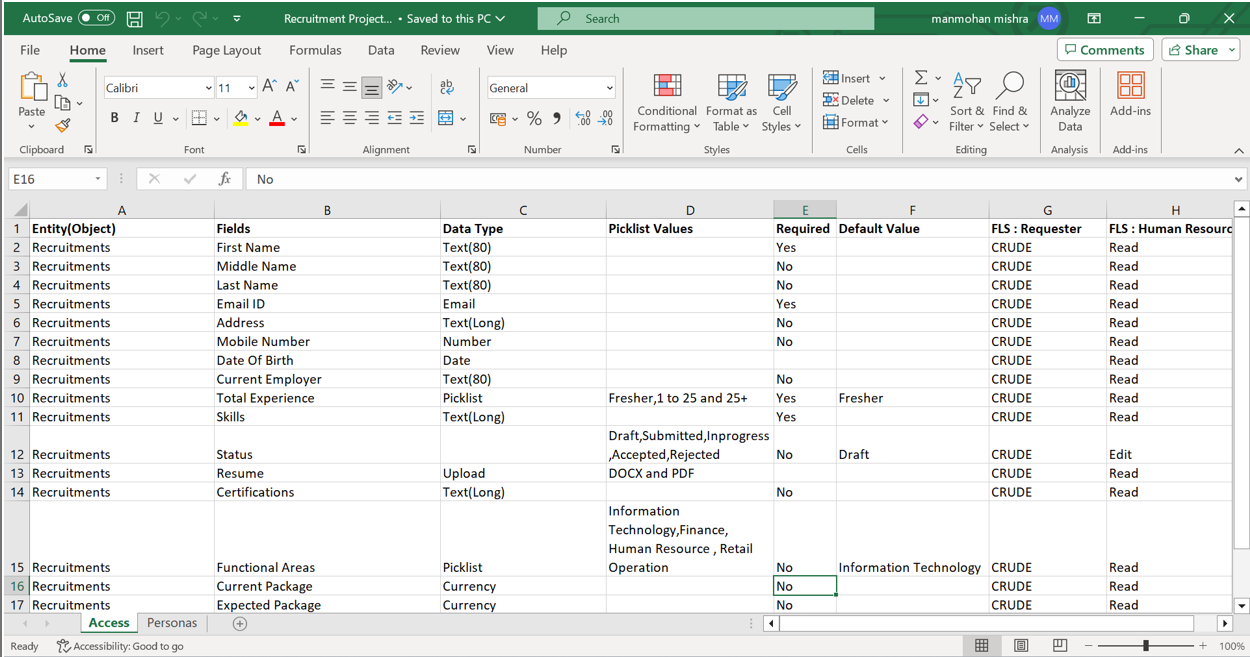
Note: CRUDE means Create, Read, Update, Delete And Edit
Conclusion
For a Salesforce manual tester, a data dictionary is a valuable tool. It improves communication with stakeholders, decreases laborious tasks, and increases test accuracy by offering organized access to information and field-level insights and it is impossible to overlook the importance of a data dictionary in testing on a dynamic platform such as Salesforce, where customizations and data dependencies are common.
Salesforce QA teams consider it a crucial component of their strategy because it helps them create test cases clearly, execute them confidently, and maintain them effectively.
Follow me on Linkedin